

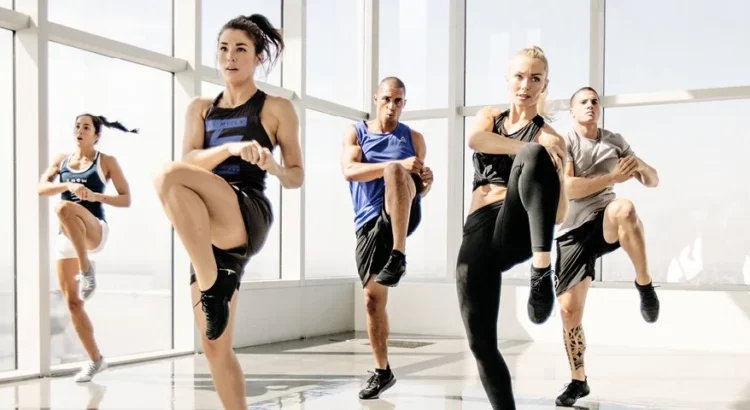
BODYCOMBAT combinations ask participants to perform more than individual punches and kicks. Movements must occur in the correct sequence, on time and in coordination with footwork.
A BODYCOMBAT class therefore challenges rhythm as well as cardiovascular fitness. As fatigue increases, participants must continue processing cues and organising movement without allowing the sequence to become uncontrolled.
Rhythm Organises Movement in Time
Rhythm is not limited to dance. It describes how movements are arranged across time.
A jab, cross, hook and knee combination has a specific order and spacing. Some movements occur quickly, while others receive more time for force or recovery.
Music provides an external timing reference. The instructor’s cues connect that reference to the movement sequence.
When rhythm is clear, participants can anticipate what comes next. This reduces hesitation and makes movement more economical.
Combinations Use Motor Chunking
At first, a participant may think about every movement separately: jab, return, cross, return, hook, reset.
With practice, the sequence becomes one larger unit or “chunk”. The participant no longer needs to solve every action independently.
This reduces mental demand and allows greater attention to speed, range and control.
At True Fitness Singapore, repeated exposure to class structures can help participants recognise familiar movement patterns even when the music or exact sequence changes.
Chunking is a skill adaptation, not mindless repetition. The participant still needs to respond when the combination changes.
Fatigue Competes for Attention
During intense exercise, attention is divided between breathing, muscular effort, balance and external cues.
As fatigue rises, participants may remember the punches but forget the footwork. They may perform the correct movements in the wrong order or fall behind the beat.
This does not necessarily indicate poor coordination. It may show that current intensity exceeds the level at which the sequence can be processed effectively.
Reducing speed or simplifying the lower-body movement can restore rhythm while maintaining useful effort.
Cross-Body Patterns Increase Coordination Demand
Many combinations link one side of the upper body with the opposite side of the lower body.
A right cross may coordinate with movement through the left side of the stance. A knee strike may follow a punch performed from the opposite side.
These cross-body patterns require communication between different regions of the body. The trunk transfers and controls force between them.
Participants who initially feel awkward may improve through repetition. The objective is not immediate perfection but a progressively clearer connection between sides.
Returning to Position Creates the Rhythm
A combination is not defined only by its visible strikes. The returns and resets determine whether the next movement can begin on time.
If a punch remains extended too long, the following movement will be late. If the feet do not return after a shuffle, the next kick may start from an unstable position.
Participants often try to improve rhythm by moving faster. Sometimes the better solution is a quicker, cleaner recovery to guard or stance.
Finishing each movement creates space for the next.
Music Can Support Pacing
Music helps participants sense work intensity. Faster sections may encourage quicker combinations, while stronger beats can reinforce powerful strikes.
However, following the music should not mean chasing every sound regardless of control.
The participant can reduce punch range or remove impact while staying with the rhythm. This preserves class flow without forcing an unsuitable movement option.
The beat is a guide. Technique and personal readiness remain important.
Instructor Cue Timing Matters
A cue is most useful when it arrives before the participant needs to act.
Late cues force people to react after the combination has already changed. Excessive cues can also compete with the music and overwhelm working memory.
Effective instructors layer information. They may first name the movement, then explain direction and finally add a technique cue once the group is moving.
This creates a predictable information hierarchy. Participants know what is happening before being asked to refine it.
Rhythm Usually Fails Before Effort Stops
A participant may still have enough cardiovascular capacity to continue while coordination has begun declining.
The feet become late, the arms move out of sequence or the participant turns in the wrong direction. These signs provide valuable information.
Continuing at the same speed may reinforce confusion. A brief reset or simplified option can restore the pattern.
The ability to recognise and correct rhythm loss is part of advanced class participation.
Familiarity Can Hide Technical Shortcuts
Once a combination feels familiar, participants may perform it automatically. This can improve efficiency, but it can also conceal reduced range or incomplete returns.
The person may remain on beat while the punches gradually become small arm flicks.
Rhythm should support movement quality rather than replace it. Participants can occasionally focus on one technical priority, such as returning to guard or rotating through the trunk.
Fatigue-Resistant Rhythm Develops Gradually
Participants usually learn a sequence while relatively fresh. The next stage is maintaining it during later rounds.
Progress may appear as fewer missed transitions, more accurate side changes or better timing near the end of a track.
This is a meaningful adaptation even if heart-rate readings or calorie estimates remain unchanged.
Rhythm under fatigue reflects physical conditioning, motor learning and attention working together.
How to Practise Without Adding Excess Fatigue
Participants can rehearse a combination slowly without turning it into another hard workout.
They can practise the order, foot placement and returns for a few minutes. Once the pattern is clear, speed can be added gradually.
Practice space must be safe, with enough room for kicks and direction changes. Floor grip and household noise should also be considered.
Short, precise practice is usually more valuable than repeatedly performing the sequence until exhausted.
Frequently Asked Questions
Q: Why do I lose the combination when the music becomes faster?
A: Faster timing reduces processing and recovery time. Simplify the movement, reduce range and focus on the sequence before rebuilding speed.
Q: Is rhythm something people are born with?
A: Natural differences exist, but rhythm can improve through repeated exposure, cue recognition and slower practice.
Q: Should I stop if I miss a movement?
A: You do not need to stop completely. Return to guard, identify the current point in the sequence and rejoin when ready.
Q: Why can I remember the punches but not the footwork?
A: Upper-body movements may receive most of your attention. Practising the foot pattern separately can reduce its mental demand.
Q: Does staying on beat prove my technique is correct?
A: No. Timing can remain accurate while range, guard or control declines. Rhythm and technique should be monitored together.